


The Lakers are not just underdogs in their second-round series against the defending champion Oklahoma City Thunder — they’re in one of the most extreme positions the franchise has seen in decades.
Los Angeles opened at +950 to win the series, marking its longest series price since 2007, when the Lakers were 10-1 against the Phoenix Suns. That alone signals how lopsided this matchup is viewed, especially with Luka Dončić expected to miss the start of the series, leaving LeBron James and Austin Reaves to carry the load.
For LeBron, this isn’t just another underdog role — it’s one of the largest of his career.
Lakers vs. Thunder: LeBron Faces One of the Steepest Underdog Spots of His Career
Only once has he entered a playoff series at a longer price, coming in at +1200 against the Detroit Pistons in 2006. That series ended in a 4-2 loss.
His other comparable spots came against elite teams as well: the Golden State Warriors in 2018 (+690, swept 4-0) and the Boston Celtics in 2008 (+600, lost in seven).
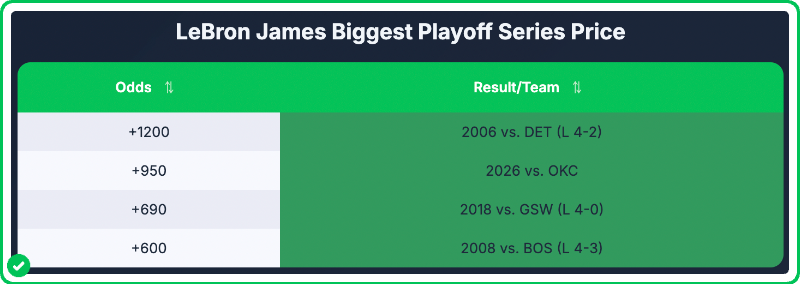
The common thread is clear — when LeBron has been priced this far out, the opponent has almost always been at or near a championship level. This Thunder team fits that description as the reigning title holder.
Game 1 reinforces just how wide the gap is expected to be. The Lakers opened as +15.5 underdogs in Oklahoma City, the largest playoff spread of LeBron’s career and the biggest the Lakers have faced in the modern era. Even in prior deep underdog spots — including multiple games against Golden State in 2018 and Detroit in 2006 — he had never been catching this many points.
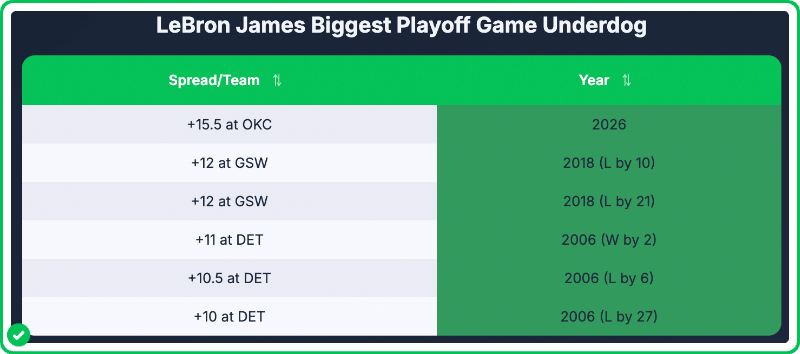
Historically, teams in this range have struggled to even compete, let alone win.
Since the NBA merger, teams that have been 13-point underdogs or more in Game 1 are just 2-26 straight up. There have only been two outright wins in that span — the 1993 Lakers against Phoenix and the 1989 Warriors against Utah — both considered major outliers even decades later. Against the spread, those teams have been more competitive, but still below expectation, going 11-16-1 ATS.
What happens after Game 1 is even more telling. Among those same 28 teams that entered a series as 13+ point underdogs in the opener, only one has gone on to win the series — the 1989 Warriors. Every other team fell short, reinforcing how difficult it is to overcome that kind of initial gap in expectation.
That context frames this series clearly. The market is not just pricing the Thunder as better — it’s placing them in a tier that historically produces very few surprises, especially early in a series. And with Dončić sidelined to begin the matchup, the Lakers enter needing not just production, but something far less common in this range — a result that breaks from nearly every precedent.


