

Right now, Taylor Swift prediction markets on wedding guests and groomsmen markets are everywhere. If you care about who stands next to who on the big day, there’s probably a contract for it. You’ll see Travis Kelce groomsmen odds, Taylor Swift bridesmaids boards, and wedding guest list markets that basically price the whole friendship circle.
On the surface, it looks like a full menu of independent odds. One market focuses on Travis Kelce groomsmen, another on Taylor’s bridesmaids, another on which guests might attend. Scroll long enough and it feels like the sports and pop-culture world already expects this wedding to happen. Underneath, they’re all leaning on the same basic assumption: Taylor Swift and Travis Kelce actually get married, and they do it in a way that fits the picture traders have in their heads. No wedding means no wedding party, no confirmed guests, and every “Will X attend?” ticket is just a different way to miss on that same outcome.
That’s narrative clustering. You get a cluster of prediction markets built around one story, and prices move together because the contracts are highly correlated, not because each market is a brand-new piece of evidence. More markets doesn’t equal more proof, and correlation ≠ confirmation. It’s a close cousin of what we cover in Liquidity vs. Accuracy, where crowded, confident-looking prediction markets can still miss.
Related: Taylor Swift Marriage Odds
Live Odds for Taylor Swift Wedding Guests
Here are the live odds for Taylor Swift/Travis Kelce wedding guests at Kalshi:
Live Odds for Swift's Bridesmaids
Here are the live odds for Swift's bridesmaids at Kalshi:
Live Odds for Kelce's Groomsmen
Here are the live odds for Kelce's groomsmen at Kalshi:
Why Multiple Swift Wedding Markets Don't Validate Each Other
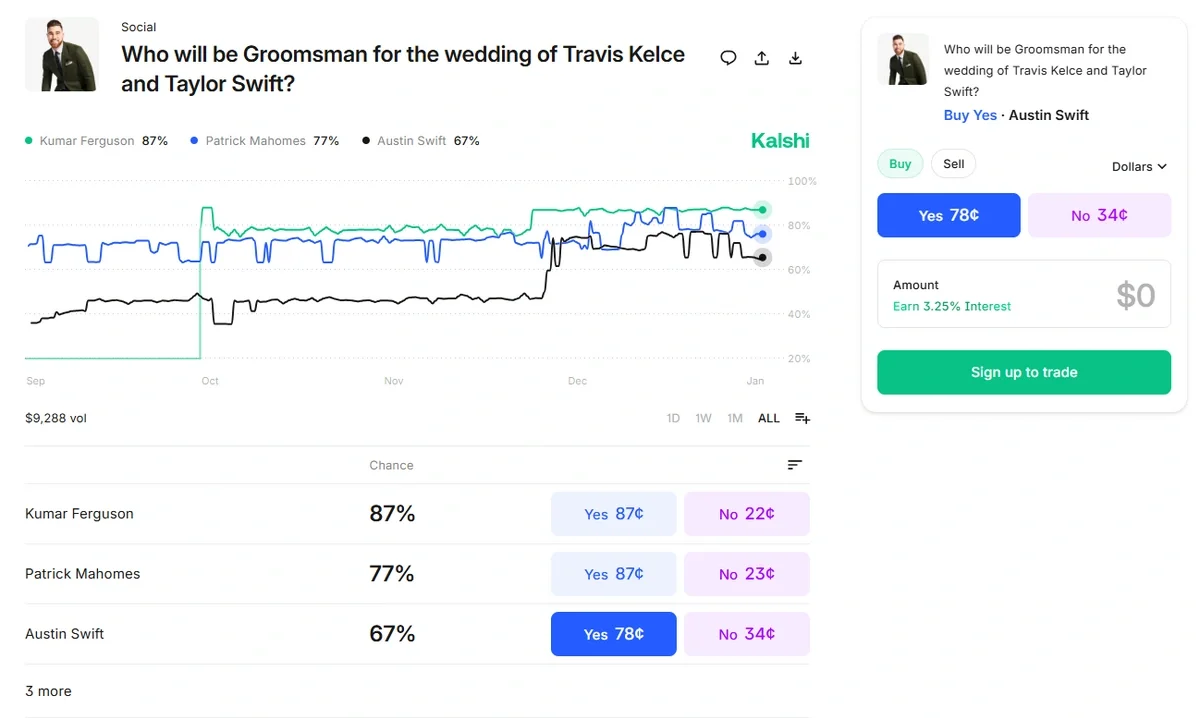
Look at what’s actually on the board. On Kalshi, there’s a “Who will be Groomsman for the wedding of Travis Kelce and Taylor Swift?” market with names like Kumar Ferguson, Patrick Mahomes, Austin Swift, Jason Kelce, and Aric Jones all listed as separate groomsmen contracts in the wedding party.
On Polymarket, there’s a “Who will attend Taylor Swift and Travis Kelce’s wedding?” market where Patrick Mahomes, Selena Gomez, Jack Antonoff, Sabrina Carpenter, Este Haim, Blake Lively, and Lana Del Rey each have their own price as potential guests.
On top of that, you’ll see:
-
A “Taylor Swift x Travis Kelce get married by a specific date” market
-
A “Will Taylor Swift and Travis Kelce be married before January 1, 2027?” contract
- And location markets on where the wedding happens, with state options like Rhode Island and New York (plus a few others) on the board.
On paper, that feels like a lot of separate information. You have a wedding date, a venue, a guest list, groomsmen, bridesmaids, you name it. Underneath, each contract is just a "Yes" or "No" on a narrow claim, like:
-
“Jason Kelce is a groomsman”
-
“Selena Gomez attends”
-
“Blake Lively attends”
-
“Wedding happens in Rhode Island"
-
“Taylor Swift and Travis are married by June 2026”
Different wording, same dependency. Every one of those markets quietly assumes there’s a public-facing wedding, inside a specific time window, where the wedding party and guests are clearly reported (or at least visible enough that best man and groomsmen are confirmed in news coverage). If that underlying story never happens, the contracts available don’t pay halfway; they just resolve No.
That’s narrative clustering in practice: one wedding rumor creates a batch of tightly linked markets. You might see the same names across a ton of Taylor Swift and Travis Kelce markets, but that doesn’t multiply the evidence that the knot will be tied. It just multiplies the ways one shared assumption can either hit or miss.
Why Are People Trading on Taylor Swift and Travis Kelce Wedding Guest Markets?
So, if all of this hangs on one wedding, why are people still piling into these Taylor Swift and Travis Kelce markets? Simple: they’re fun, low-maintenance, and you don't need to break down Kansas City Chiefs tape to have an opinion on the wedding party or who makes the guest list. For a lot of fans, it's just gossip with odds.
Then there's the pattern-reading side. Traders scroll Instagram, replay every engagement announcement, and watch suite shots from Arrowhead, Wembley, New York, etc. Out of that you get theories like “Patrick Mahomes is always around Travis, so he has to be in the wedding party", or “Abigail Anderson and Austin Swift have been in the picture forever, so they probably show up on at least one bridesmaids or groomsmen board.”
It feels a bit like soft inside information. When the couple is everywhere in the news cycle, every weekend or quick trip between Kansas City and New York starts to look like a signal instead of just another week in their life. And as crazy as it may seem, none of that is unreasonable. People use these markets as another way to follow the story.
The one thing you cannot lose sight of though is the structure underneath. A Travis Kelce groomsmen market and a guest-attendance market are different questions, but they still depend on the same wedding actually happening. Fun and engagement don't turn correlated trades into independent evidence.
How One Rumor Creates Multiple Swift/Kelce Wedding Markets
It all starts with the engagement announcement, which triggers a wave of media coverage, hints at a future wedding date, and maybe even teases honeymoon plans or what life might look like after football. By the time those stories are done, most fans have accepted that there's a big day somewhere on the horizon, even if the timeline is fuzzy.
Platforms don't wait for every detail to be nailed down. The first contracts that show up are the straightforward ones, like “Taylor Swift x Travis Kelce get married by a specific year", or “Will Travis Kelce and Taylor Swift be married before a specific date.” Once those anchors exist, the same rumor just gets sliced into more tradeable angles.
All the extra boards you see later (venue, wedding date, wedding party slots, and guest list prices) are follow-ups to that first “Will they get married?” line. It can feel like the market has triple-checked the outcome and it feels bigger because it's everywhere, but it's still one story chopped into tickets, and reading it four times doesn't change the underlying facts.
Prediction markets behave the same way. One rumor turns into a chain: Rumor → “Married by 2027” → “Where is the venue” → “Who is in the wedding party” → “Who gets an invite”. If that core rumor fails, the whole chain moves together. That's why these Swift and Travis Kelce wedding markets are not diversification. You're not spreading risk across unrelated stories; you're spreading it across different angles on a single event that may or may not happen.
Final Thoughts on Travis Kelce and Taylor Swift Wedding Guest List Markets
Put it all together and the wedding guests and groomsmen markets show narrative clustering in action. One story about Travis Kelce and Taylor Swift getting married turns into a whole set of contracts on who stands where, who gets an invite, and how that big day looks.
It can feel like a pile of separate odds: Mahomes talk here, Jason Kelce in the wedding party there, and bridesmaids rumors and venue pricing layered on top. In practice, they are branches of the same speculation tree. And there's nothing wrong with following or trading them if you enjoy the story, but the risk is tightly linked. If the wedding never happens on the timeline these contracts expect, those guest and groomsmen positions move together, not one by one. Correlation ≠ confirmation.
Read Next: Best Prediction Market Apps
When they’re listed, you’ll usually see Travis Kelce groomsmen markets on places like Kalshi, while crypto-style boards on Polymarket will sometimes post similar wedding party contracts. What you see on your screen depends on where you live and what's currently open, so the exact menu of markets can change week to week.
Sometimes, yes. The same places that price groomsmen odds have also posted bridesmaids props for Taylor Swift, usually built around close friends like Selena Gomez and the rest of the long-term inner circle. Just remember: bridesmaids and groomsmen markets share the same risk structure. No wedding that matches the contract, no payout.
The usual names on guest list markets are Patrick Mahomes, Brittany Mahomes, friends from inside the entertainment world like Selena Gomez, Blake Lively, Lana Del Rey, Jack Antonoff, family such as Jason Kelce, Kylie Kelce, and Austin Swift, plus a few other faces we've seen around. They show up because of visible friendship, Kansas City Chiefs ties, or past history with Taylor Swift and Travis, but prices and rumors are not the same thing as a confirmed invite.
Big stories get chopped into a lot of different questions. Once Taylor Swift was engaged to Travis Kelce back in August 2025, platforms created even more markets on the wedding date, venue, guests, and roles. Why? Because fans and traders like having options. Just remember that all that action tells you there’s demand to trade the story, not that the wedding itself is guaranteed to happen.
No. Multiple guest lists or venue markets usually reflect narrative clustering, not higher probability. These contracts are all built on the same underlying assumption. If that assumption is wrong, the markets can all be wrong together. So seeing more wedding-related markets doesn’t make a Taylor Swift–Travis Kelce marriage any more likely.