


Many 21st-century sportsbooks never let you parlay two bets from the same game, like a point spread and the over, because those bets could be correlated. If one happens, the other is more likely, so they didn't want you to get the full multiplier value a parlay offers.
Then magically in 2019, FanDuel began letting bettors create parlays on the same game and started marketing it like crazy. They called it the Same Game Parlay, it became wildly popular, and every major sportsbook launched its own version.
And still, it's the fuel to the modern sportsbook's profit margins.
Same game parlays can be as small as two bets, like Chiefs -4 and over 52.5 at something like +200. But most bettors are looking to tie a bunch of props together to create a lottery payout — sometimes north of 50-1, or even 250-1.
At many books, you can add player props, game props and winning margins. The list feels endless.
Sportsbooks make huge profit margins on parlays.
SGPs are big moneymakers for sportsbooks, and bettors love to chase lottery payouts with small wagers on games they're watching anyway.
You're never really getting a fair price, but if American bettors were concerned about what's fair, they'd probably find a new hobby altogether.
Here's an eclectic mix of 14 tips, strategies, warnings and ideas to think about when betting same game parlays, since you're going to do it anyway. (Examples are from previous seasons.)
The Basics
1. What is a Same Game Parlay?
It's a parlay with multiple bets from the same game. You must win every leg of the bet for it to cash.
Sportsbooks have productized same game parlays and put certain rules around them. You can't parlay everything, but the following are usually on the table:
- Spreads
- Totals
- Every derivative of those (first half total, alternate spreads, etc.)
- Player props
- Game props (like first team to 10 points, will there be a fumble)
FanDuel has a separate tab for SGPs, and the bets will populate in your bet slip. You can only parlay bets from that tab, not everything offered on that game.
2. SGP Examples
Here's a simple SGP example.
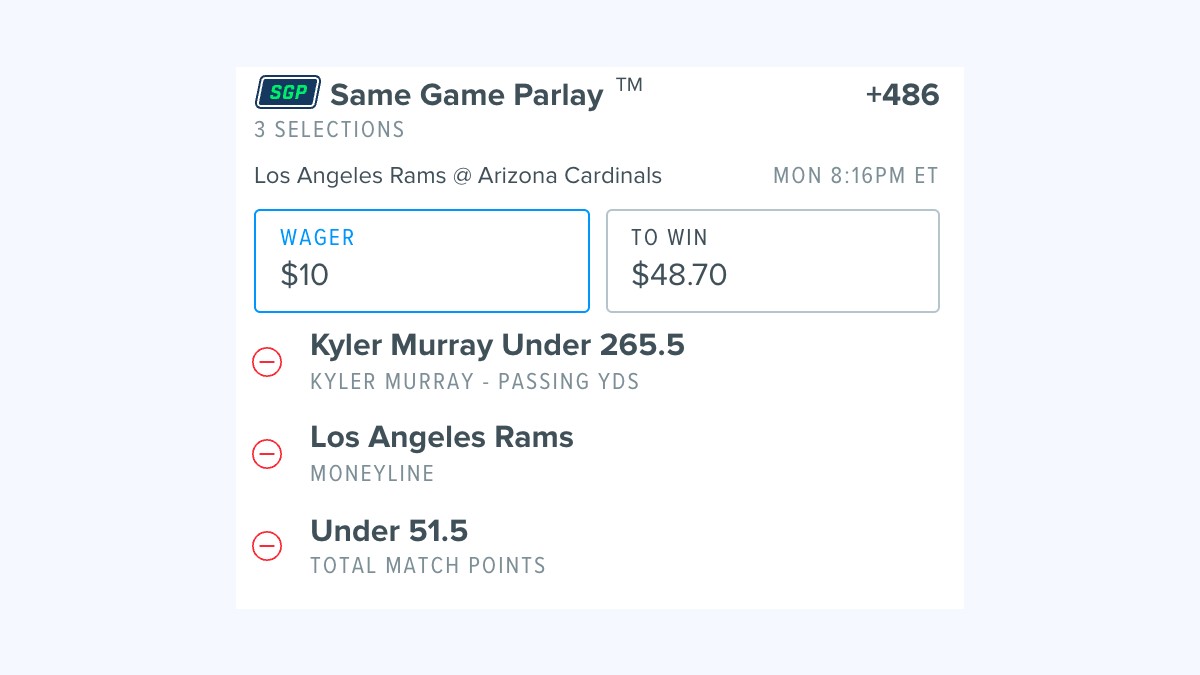
You may like the Rams to win a lower-scoring game against the Cardinals. So you tie these three bets together for +486 payout.
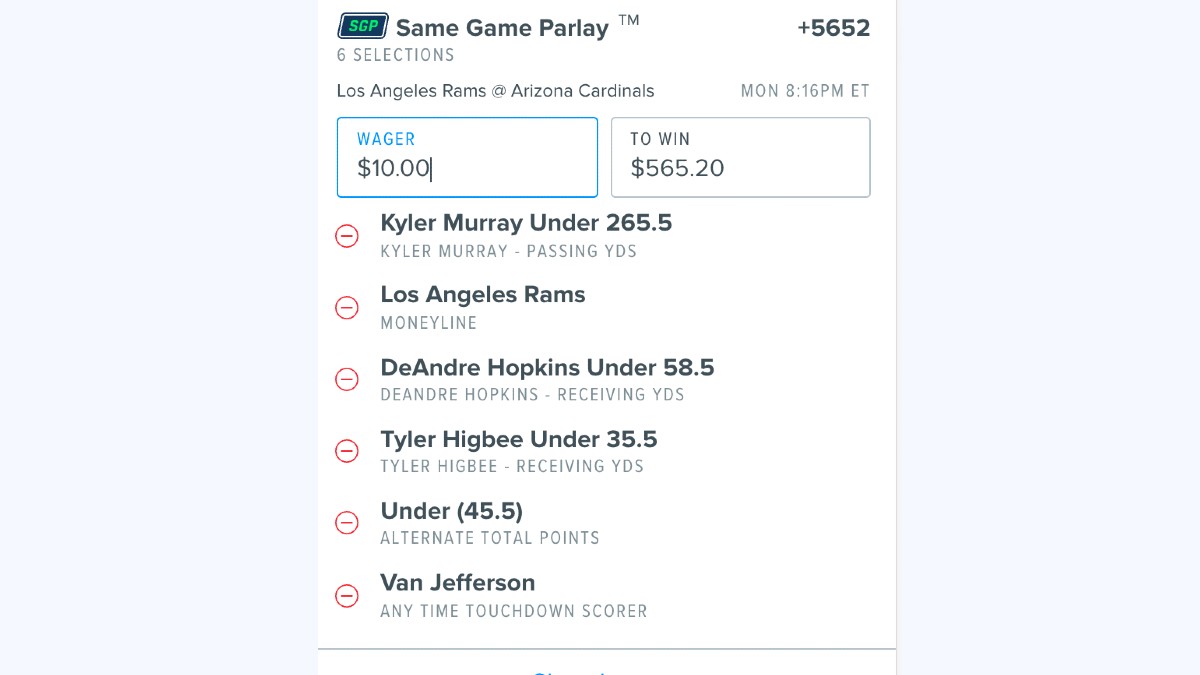
Now let's keep the same theory about this game and add to it.
You like the Rams to win a low-scoring game, but youn think Van Jefferson will be a key contributor for L.A., and two other players will go under their totals. It all still fits with your original theory/narrative, but now the payout is over 56-1.
The Math
3. Making sense of some math
TL;DR on the math: It's complex, the book gives itself an even bigger edge than normal, and they account for almost every related outcome.
Sportsbooks get the complicated math and tech from specialized data providers, who are quite good at this. DraftKings uses Genius Sports for some of its SGP data, and a few other books likely do too. DK and FanDuel are always striving to bring this tech in-house so they can control and develop it, but it's quite difficult.
The books/providers are always going to be better at the math than you and me, and even if you can close the gap, they build in a ton of padding to protect themselves.
Any edge you think you're getting with correlated outcomes, they've accounted for and gutted the price accordingly.
The Chiefs covering -6.5 in the first half and -10 over the full game vs. the Raiders are correlated. If the first happens, the second becomes much more likely.
So the book isn't giving you the full prices on a two-bet parlay, which normally pays +260 (even though the true probability is +300).
Example 1: The Tax
There are three main ways a sportsbook cuts your payouts on SGPs:
- The existing juice on each bet (like -110 on an NFL spread)
- Correlations
- This other random tax they throw on, just because
The first two make sense. The third is just rubbing it in.
So how do we figure out this random extra tax?
Let's use the Colts -2.5 (-112) and Jonathan Taylor rushing yards vs. the Patriots. If the Colts cover, it's more likely Taylor ran for more than 90.5 yards to ice the game, so a parlay with his over pays less than one with the under.
Here's what each pays:
Now here's how we figure out the tax (stick with me).
I've created a scenario where I'm betting both those parlays and risking one total unit split between the two. If there was no tax, I'd win one unit no matter what if the Colts covered and lose one unit if they don't.
But there is a tax!
Because if the Colts cover, and either result happens with Taylor, I only return 1.78 units. If the Colts don't cover, we lose one unit.
Risking one unit and winning .78 units implies a -128 moneyline.
That means in this parlay, FanDuel has turned Colts -2.5 from -112 to -128. That's a break-even rate of 56.14% compared to 52.83%.
That's 3.31% in extra vig for the book, on top of the 2.83% juice they're already charging you.
Highway robbery, and FanDuel often has the best pricing for SGPs!
Example 2: Separating Correlation
We now know the sportsbook is secretly giving itself an extra at least a 3%+ edge for extra cushion on every parlay, and likely higher in a lot of cases.
I also wanted to give some insight into how the book separates correlation among bets in a parlay, though there's so much more math out of my scope that goes into how they determine the amount of correlation between each bet.
Take this example:
- Chiefs -10
- Chiefs -6.5 first half
- Over 47.5 full game
A three-leg parlay with each at -110 normally pays +595. This one pays +357.
We have two highly correlated bets — Chiefs and Chiefs 1H — plus a third that's slightly correlated to both (since favorites cover more often when the game goes over).
A +357 parlay compared to a +595 parlay is a 7.5% difference in break-even rate.
But how does it break down between the three bets? The chart below shows you.
The correlation that's costing you is the Chiefs full game and first half spreads. Makes sense. They're more correlated.
FanDuel offered +143 for Chiefs -10 and -6.5 1H, compared to +260 for a normal two-team parlay — a 13.37% probability cut.
I tried to figure out some of the correlation math, and even turned to some of the smartest folks at Action to help, with little luck.
From our Data Engineer, Billy Doyle: "There's really no way to know exactly what they're doing without a lot of data from books."
This is all to say we'll never beat the books on correlation for most things– if you think you're pulling a fast one on 'em by parlaying Justin Herbert 3+ touchdowns with Chiefs -3.5, they're accounting for it.
The books have better math and build huge cushion to protect themselves, even if some math is exploitable. And if correlation for a prop can't be easily accounted for, they just don't offer it.
We'll get into it toward the end, but there are some situations in which you can take advantage of their use of "average" correlations by exploiting certain coaching tendencies or matchups, particularly in complex sports like football.
4. Some books will gouge you for non-correlated bets, too
The books should adjust your prices for correlated outcomes on parlays. That's what makes SGPs a fun, lottery-style game.
But some books will shave the price even for two completely unrelated events. Not every bet influences another in a single game, but that's how it's treated, just because they know they can get away with it.
Example 1: Independent Events
A running back (+150) and a wide receiver (+400) each scoring a touchdown in the same game aren't really correlated. They're independent events (and perhaps even a tiny bit negatively correlated, since there are only so many TDs to go around).
If you added other bets to that parlay, like a moneyline or total, then a correlation begins to form.
So, why shouldn't you get the full price for that simple two-bet parlay? DraftKings could pay out +1000 for that running back-wide receiver parlay, which should be +1150 given the +400 and +150 prices.
- DK Parlay Payout: +1000
- Normal Payout: +1150
- Probability Difference: 1.09%
Going from +1150 to +1000 doesn't seem like much, but it's more than a 1% difference.
DK would be taking an extra 1% for no reason, on top of the normal juice, on top of the parlay tax. Highway robbery.
Example 2: Same Bet at the Same Book, Worse Price
Sometimes sportsbooks will offer you better prices on certain pre-made parlays than on SGPs.
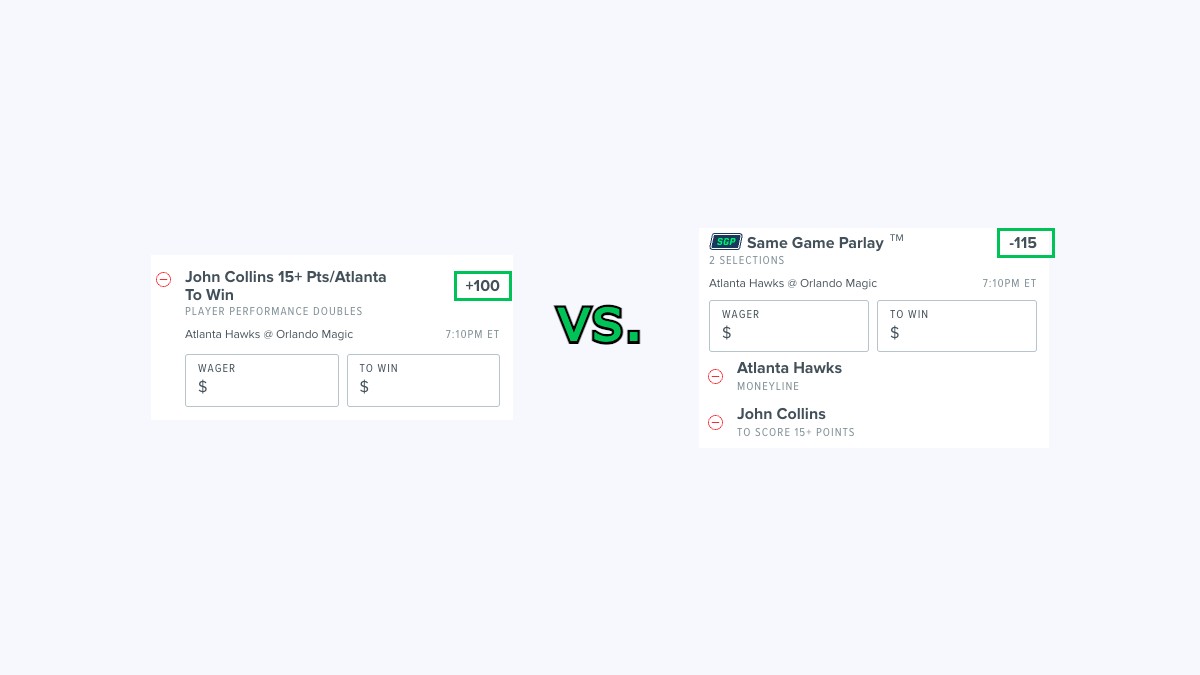
Back in a previous season, John Collins to score 15+ points and Hawks moneyline paid -115 in an SGP, but it paid +100 under FanDuel's "performance doubles" for the exact same thing.
5. Odds increases are not created equal
Sportsbooks don't want you to think about odds in probabilities. They just want your eyes to light up when you add one more bet to your 10-pick, same game parlay to take it from 150-1 to 500-1.
The implied probability of hitting a 150-1 parlay is .66%. Hitting a 500-1 parlay has a .20% chance. It was already incredibly unlikely to hit.
The big changes are in lower numbers.
The drop in probability from +200 to +450 is 15.15%.
That's the same drop in probability from +450 to +3200.
You may think going from +200 to +450 isn't a big deal when it comes to the chances of hitting your parlay. But it's an incredibly big difference.
Try to contextualize odds changes by percentages, not by American odds.
Best & Worst Sportsbooks for SGPs
6. The best books to bet SGPs
Most of the major American sportsbooks are starting to offer same game parlays because 1) bettors love them and 2) they're advantageous for the books. Win-win, I guess.
You can read more about our favorite SGP books here.
Our Favorites
- bet365: Best combination of available bets, UX and pricing.
- FanDuel: bet365
- DraftKings: DK has made big improvements to its SGP product since this article was first published. The pricing still lags behind, but the UX has caught up.
1. FanDuel
FanDuel was the first to market with SGPs and has maintained its lead. The pricing is transparent, unlike some competitors, and they have plenty of props to bet.
FanDuel doesn't have quite as many bet types as DraftKings, but they have a good menu overall.
2. bet365
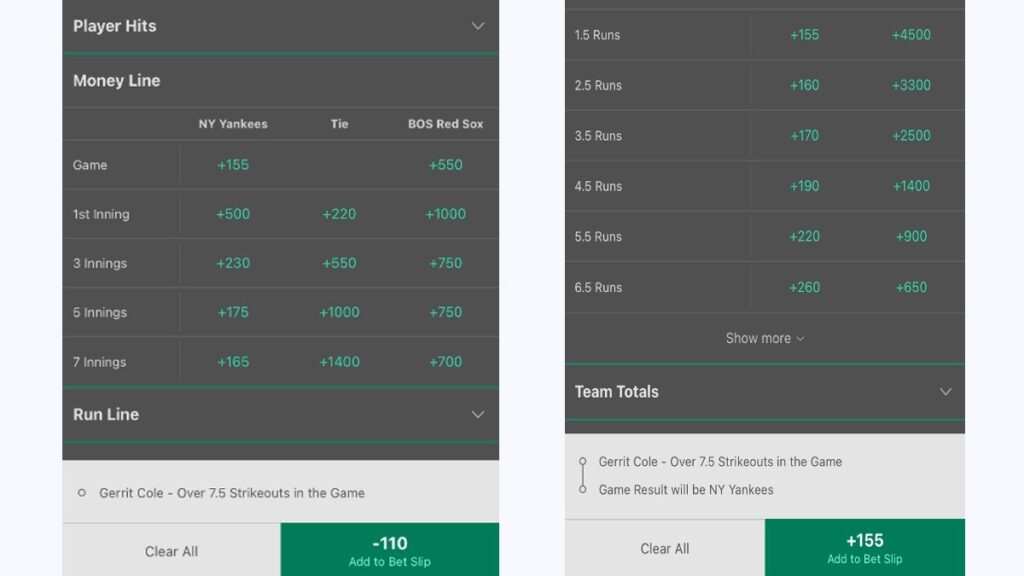
bet365 has loads of available props, including alternate lines for NBA, MLB NFL and uses what we call "dynamic display pricing." Most sportsbooks make you add a leg, then the price updates in the bet slip. But at bet365, you can see it all as it develops.
Here's an example — say I have Gerrit Cole strikeouts in my SGP first (left screenshot below). Without having to add another bet, I can see what all those other bets would be if I did add them — Cole over 7.5 K's and Yankees full game moneyline is +155, or Cole over and Red Sox moneyline is +550.
Same with the right screenshot. I have two legs added already, and if I go to add an over or under, I can see what those prices are.
3. DraftKings
DraftKings has made big improvements to its SGP product (and the app in general) in the last few years. They now offer dynamic pricing like bet365.
7. Avoid books that hide the odds
Try to avoid SGPs at books that don't show you the odds on every individual prop. They're trying to make you forget how bad the pricing is.
If I want to bet the Chiefs alternate spread of -13.5 and Chiefs team total over 35.5 points, they don't show you the individual odds for each — only the final parlay price. It's helpful to see the odds for each to better contextualize how likely these things are to happen.
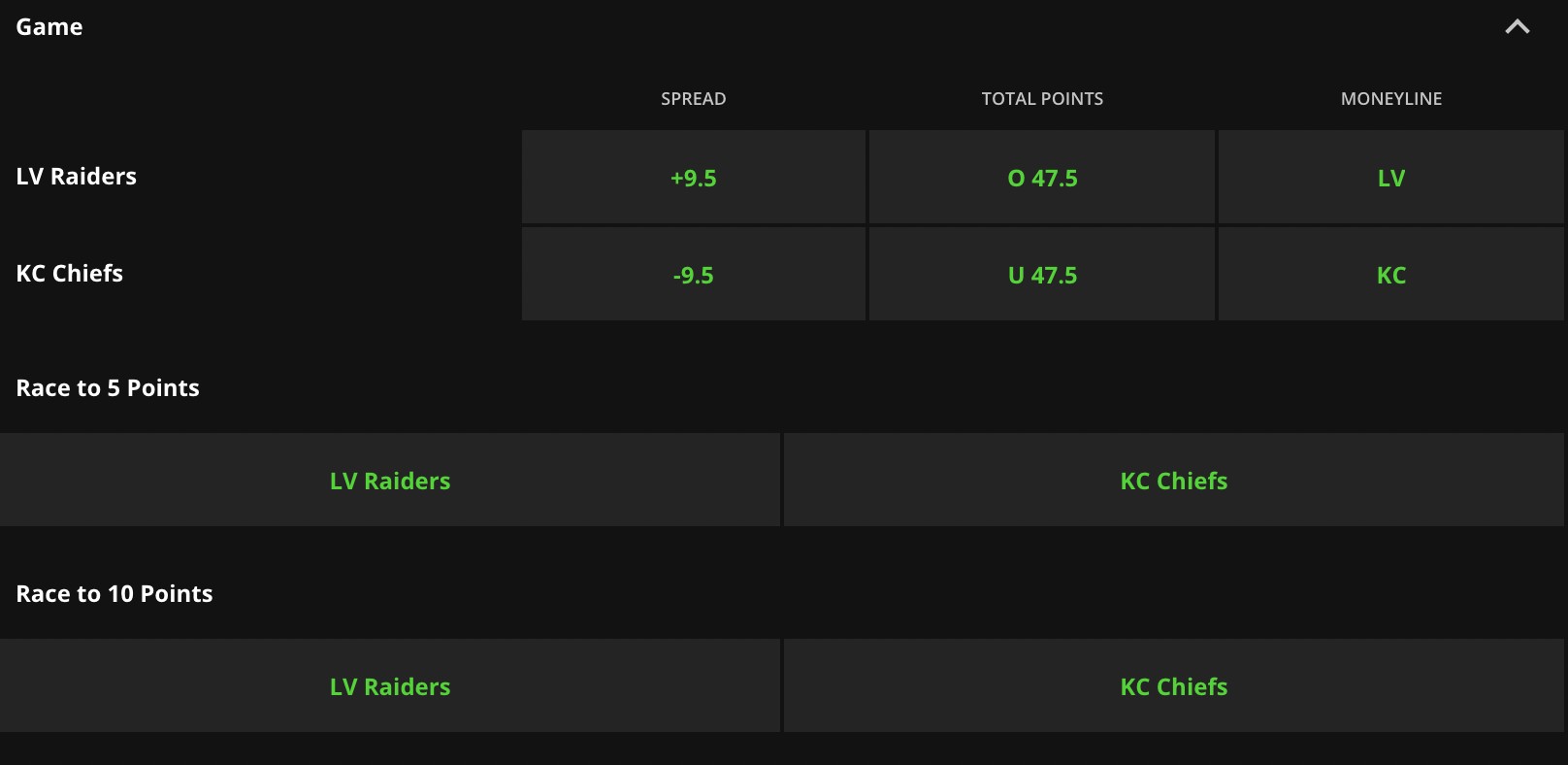
DraftKings has since changed its product to 1) show prices and 2) even show what the price will be if you add the next leg, like bet365 does.
That same Chiefs parlay from above pays much worse at DK than at FanDuel.
DraftKings also requires you to add the same-game parlay to your bet slip, but you can't edit it once it's been added — you either need to bet it or start over.
Strategies & Tips
For sportsbooks, pricing same game parlays is like plugging leaks. As soon as you find and close one, the next one opens. Then you plug that one, and another across the boat springs. Then eventually, they just kick out the bettors causing the leaks.
But this is what we're trying to exploit. We just need to exploit one inefficiency to score a huge win. Here are some ways to do that.
8. Finding usage changes before they change
Sports statistics in a single game are just a giant pie chart based on the distribution of opportunities.
Sportsbook models aim to simulate a game, and they change dynamically if players are ruled out — so if Steph Curry is out for the Warriors, the spread, total and every prop will change, usually all at once, based on how they expect the game to go without Curry. Or they'll take everything off the board until they have time to adjust.
But let's talk about usage for a second. If Curry doesn't play, his field goal attempts per game will go to other players. They don't just disappear (in football, this isn't the case, because it's hard to move down the field and score; in basketball, every NBA team is going to get shots up).
Example 1: Using our NBA On/Off tool at FantasyLabs, you’ll often see a secondary scorer’s share of team production jump significantly when a primary option is off the floor.
A player who normally accounts for around 15-18% of team scoring might jump to 25-30% in those situations.
If that player is listed at long odds to hit a scoring milestone (like 25+ points), those odds are based on the assumption that the star player is active. If the star is ruled out, the market will adjust quickly — sometimes cutting those odds in half — because the available usage is now being redistributed in the sportsbook’s model.
Of course, sportsbooks know this and do a few things to combat it.
- They don't list every player.
- They play it safe with injuries and don't list players who will have big swings in usage if another player is ruled out.
- They don't add new players when one player is ruled out.
- They're often just as fast reacting to change these prop prices, but not always. You can catch them napping on some derivatives.
Try to look for situations with questionable players where that player is still listed as an option to bet before being ruled out.
Example 2: The key is to find outlier situations that the normal range of outcomes doesn't account for. This often comes from coaching and philosophy shifts in football.
For example, say an NFL team ran 3WR sets on just 55% of its plays from Weeks 1-12. Then without its star tight end in Weeks 13-14, it ran 88% of plays with three wide outs. This would allow a boost for wide receivers on the squad, not a material bump for another tight end.
A book's models will account for increased usage without a star tight end, but they won't be able to account for the the team changing their offensive formations that so many of the tight end's snaps and targets would go to a specific player.
9. Form a narrative but add a contrarian element
We form beliefs about a game and then bet them. This is not exclusive to SGPs. This is sports betting for most people.
One good way to juice up your parlays is to use a prop that fits the opposite narrative of everything else you've bet.
In this case, we'll get a negative correlation, which increases your payout (sometimes considerably).
In a previous NFL season, betting Matthew Stafford over 283.5 passing yards and Van Jefferson over 50.5 receiving yards paid +192. The same Jefferson over and Stafford under paid +362 — almost a 13% difference in probability.
So what's the strategy here? Create parlays with correlated bets, then include 1-2 that don't fit that narrative but will give you some upside and still fall within a reasonable range of outcomes.
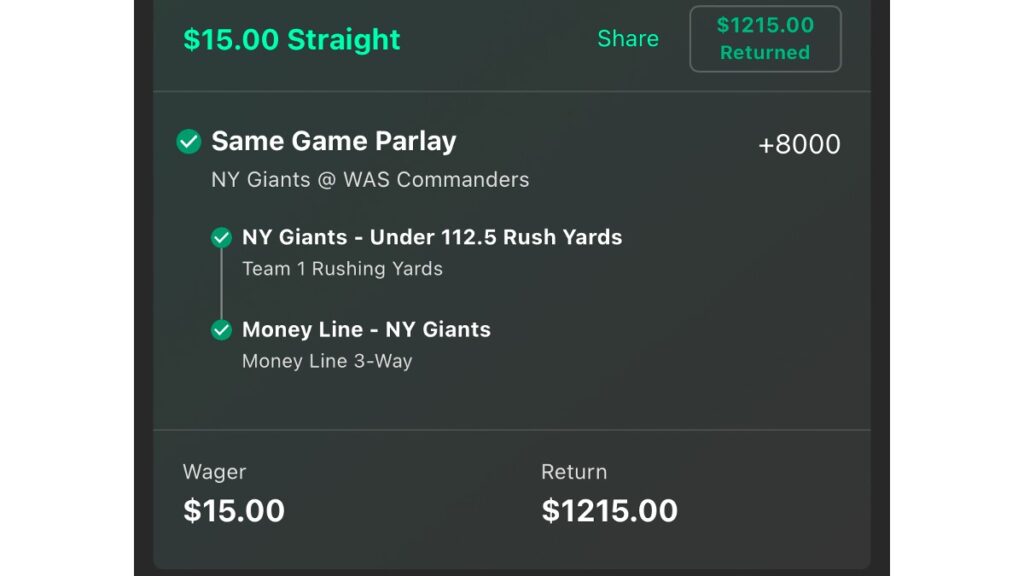
Example: This was a fun one I hit during the 2023 NFL season. The Giants were a big underdog to the Commanders, and bet365 (as it should) correlates winning with rushing for more yards.
But the Giants' running game had the lowest EPA per rush entering the game and I figured 80-1 was worth a flier that they pull off the upset in some lucky way without running for tons of yards. That's what happened, with the Giants forcing six turnovers to win.

10. Look for games with asymmetric upside (or downside)
You want to identify situations where if the bottom falls out, it will really fall out. Or if the lid gets blown off, it really gets blown off.
Example 1: In hindsight, Bills-Patriots in the snow and wind on Monday Night Football in 2021 had that downside.
The snow and wind were so bad that QB Mac Jones and every Patriots receiver finished under their props because the Pats threw the ball three times. The correlation for all those unders was baked in, but a book's pricing models can't account for extreme outlier situations like the Patriots deciding to literally not throw the ball.
A bettor cashed a 400-1 parlay with this exact scenario playing out.
The all unders parlay turns $50 into $20.7K 😳
(via @valonk17 | @FDSportsbook) pic.twitter.com/IX0hYSrMWC
— Action Network (@ActionNetworkHQ) December 7, 2021
Example 2: The Giants and Padres played in a tiny ballpark at insane elevations in Mexico City in 2023. DraftKings initially didn't price the total for this favorable offensive environment at all, and even the rapid move from 9 to 14 wasn't close to enough.
The teams combined for 27 runs, 30 hits and 11 home runs in Game 1 of a two-game set in Mexico.
Some MLB folks started pointing out how ridiculous the scoring might be the day before the game.
/THREAD The #SFGiants and #BringTheGold play in Mexico City this weekend and holy shit it's going to be Coors Field on steroids
Here's everything you need to know about the park and the HIGHEST RUN TOTAL THE BAT X HAS EVER PROJECTED… pic.twitter.com/LAezWiCNbE
— Derek Carty (@DerekCarty) April 28, 2023
And if you were paying attention, you could have cashed in with insane same game parlays.
For the second game in Mexico City the following day, FanDuel got so scared they just turned SGPs off. Naturally, that game finished with just 10 runs.
Did Fanduel remove the option to same game parlay HRs for the Mexico City game? 😂😂
— Fantasy Genius (@FantasyGenius4U) April 30, 2023
Outlier situations can often come from strange playing surface conditions (wider rink in hockey, small park in baseball, playing basketball on an aircraft carrier), weather and injuries. Pay attention, and you'll find one.
11. Think about the distribution of stats in a single game
Most results in football games fall into a reasonable range of outcomes. Based on teams, the spread and the over/under, we can estimate how many touchdowns and yards there will be.
But it's so difficult to try to predict a team's entire stat profile. There's only so much to go around and it's unlikely in football that everyone on an offense goes off.
Betting three players from the same team to score anytime touchdowns is a difficult proposition, even if the game is higher scoring than normal.
It's the same way with yardage. There are only so many yards to go around, so betting three players to have 70+ receiving yards is so difficult.
Instead, mix and match yardage props, touchdowns and other game props.
Let's take a look at a well-distributed SGP that did hit big.
Oh my goodness I just hit the SGP of my life. On Thanksgiving no less. Going to put a chunk of this towards good causes, but first a little celebration! pic.twitter.com/LvIleLSQVJ
— Cal Spears (@CalSpears) November 26, 2021
Based on the over/under (51) and each team's season averages, we can guess there would be about six touchdowns scored and 800 total yards in that Cowboys-Raiders game.
So with Cal's six props, he only needed to correctly guess about 20% of the total yards and 33% of the available touchdowns. Still a very difficult thing to do, but it's better than trying to guess every single yard or TD.
He needed a few things to happen for this narrative to play out:
- The Cowboys to move the ball at their normal rate (~415 yards per game)
- The game to stay competitive, which would likely help running backs add a few catches late
- Michael Gallup to shine with Amari Cooper/CeeDee Lamb out
- DeSean Jackson to hit one big play
That doesn't sound so impossible, especially for 265-1!
It becomes more difficult if you need Gallup to hit 100+ yards, Zeke to run for 65+ yards, and Dalton Schultz to hit 55+ yards. Now you're trying to predict more than half the Cowboys' total yards.
We fool ourselves into thinking that if an offense goes off, everyone will go off.
Even in a big offensive game, there's only so much to go around. Don't add too many big yardage totals from the same team or try to predict 3-4 touchdowns from the same team.
12. Chase opportunities, not results
This applies to most things in sports betting. Worry about opportunities, not the previous outcomes.
Anytime touchdown scorers are especially popular in SGPs. Look at who will be on the field, and who gets touches/targets. There's a lot of randomness in touchdowns week to week.
It's the same way for basketball — the best indicators of success in a single game are simply how often a player will be on the floor and touching the ball.

13. Dig Deep for Inefficiencies
Example 1: If the books had to do it all over again, they wouldn't have allowed the parlay below. Jakeem Grant and Chicago D/ST scoring a touchdown were highly correlated, because Grant was the Bears punt returner.
Even if they do allow this parlay, it should have paid closer to 30-1, not 240-1, with the correlation of Grant. But they missed it entirely.
Of course, FanDuel changed this shortly after so special teams was not included with defensive TDs.
AN ABSOLUTELY ABSURD PARLAY 💰
(via @kiiLkenny | @FDSportsbook) pic.twitter.com/xTq9Rcsysk
— Action Network (@ActionNetworkHQ) December 13, 2021
These "errors" are only shared in private circles and Discords because no one wants the books to catch on.
But dig deep for inefficiencies in the book's product, and hold onto those edges for as long as you can. They'll close the holes eventually, then you'll need to find a new one.
Example 2: If you want to make some money and then get banned, you can do this. But if you care about your DraftKings account and would like to keep betting there, try to avoid exploiting these "clear and obvious" errors.
DK offered LeBron James' first quarter props as full game props by accident, so 138 bettors made $4M worth of bets and profited $575,436 when he easily eclipsed those props — over $4,000 a person.
Some states forced DK to pay those bettors out, others did not. But you can be sure almost all of those 138 bettors were limited or banned shortly after.
14. Remember that everything is designed for overs and "yes" props, and there's a reason for it
It's human nature to root for things to happen. No one wants nothing to happen in the games they bet, especially a standalone, national TV games where SGPs are so popular.
The SGP products have all been designed with this in mind. They want you to bet overs and yes props, even if they offer unders now.
1. They give you worse numbers on overs and favorites
For Chiefs-Chargers on Thursday Night Football, DraftKings' regular markets had Chiefs -3 and the total at 52.
Flip to Same-Game Parlay mode, and the Chiefs are -3.5 and the over is 52.5. They know you're going to bet favorites and overs, and will shade lines towards that (and not give you a better price on them).
2. So consider some unders, please
Ever hold your breath every time a QB throws a pass, hoping it doesn't go to the guy whose receiving yards under you bet? Yeah, it's pretty awful.
But props go under more often than they go over against the closing line.
15. Final Thoughts
The house has an even bigger edge than normal here. You'll never get fair prices based on the actual probability.
But you're going to bet SGPs anyway. If people were turned off by getting an unfair shake, they wouldn't bet on sports at all.
Your biggest asset is you just need one outlier situation that the books couldn't account for in a normal distribution of outcomes.
Hopefully some of these ideas can help you create one.


